
There are many ancient historical characters who stand on the side, hidden, ostracized from the world’s memory. This was the case of Arsinoë IV, half-sister to Cleopatra VII.

Arsinoë was born around 63 BC, the fourth of six children and the youngest daughter of Ptolemy XII Auletes and possibly a woman, whose identity historians aren’t sure about, indeed Cleopatra V, mother to the most famous Cleopatra VII, had died or had been presumably repudiated not long after Cleopatra VII was born.

In 51 BC, King Ptolemy XII died, leaving his reign and legacy to his eldest son and daughter, Ptolemy and Cleopatra. The two had to be wedded and to rule over Egypt as King and Queen, though, soon, the contrast between brother and sister became unmanageable and Ptolemy placed his coup d’état, dethroning Cleopatra, leaving the young queen no choice but fleeing from Alexandria.
Meanwhile in Rome, civil war had started between the once-friends Pompey and Julius Caesar, casting the Republic in great distress. Caesar had started pursuing Pompey along Italy, Macedonia and then Egypt where the Triumvir had landed after the defeat in the battle of Pharsalus, beseeching the help of King Ptolemy XIII. The advisers of the young King were no fools and knew that being enemy to Caesar would have meant war, so, in the attempt to secure the favour of the Roman General, he had Pompey beheaded, presenting his head as a welcome-gift on the entrance of Julius Caesar in Alexandria, signing the end of any possibility of an alliance between Caesar and Ptolemy- indeed, on one side, Ptolemy had killed a Roman, breaking the rules of the treaty with Rome, on the other side Caesar was denied the honours of defeating his long-time friend and foe.
The deed led Caesar to join forces with Cleopatra. Thus, he reinstated the young Queen to her throne, as decided by Polemy XII’s will, Cleopatra and Ptolemy XIII would have ruled Egypt together, and, in a similar gesture, he restored Cyprus to Egypt, according its rule to Arsinoë and her youngest brother, Ptolemy XIV. In order to avoid other troubles, the Roman General had Ptolemy’s regent, the eunuch Pothinus, executed while the general Achillas escaped and began besieging Alexandria.
At that point, Arsinoë ran away from the capital with her mentor, the eunuch Ganymedes, and, thanks to the support of the Egyptian army, she proclaimed herself Queen as Arsinoë IV. The Egyptians enjoyed some success against the Romans, trapping Caesar in a section of the city by building walls to close off the streets and having seawater released into the canals that supplied Caesar’s cisterns. Caesar realized he had to break out of the city, by taking control of the harbour, thus he threw an attack to seize control of the Lighthouse of Alexandria, but Arsinoë’s armies drove him back. Almost about to be defeated, Caesar undressed and swam to a Roman ship, sailing nearby. The bug turning point arrived not so long after, the Egyptian officers got rather dissatisfied with Arsinoë’s commands stirred up the soldiers to stop the battle and negotiated with Caesar to exchange Arsinoë for Ptolemy XIII.
After the release of Ptolemy XIII, the young King carried on the war until the Romans reinforcements arrived and inflicted a decisive defeat upon the Egyptians. Arsinoë, now a Roman prisoner, was transported to Rome, where in 46 BC she was forced to appear in Caesar’s triumph and was paraded behind a burning effigy of the Lighthouse of Alexandria, which had been the scene of her victory over him. Although the practice of strangling the most important prisoners in triumphs, Caesar decided to spare Arsinoë and granted a shelter at the temple of Artemis in Ephesus.

The princess lived there for her last few years,indeed Cleopatra perceived Arsinoë as a threat to her power and, in 41 BC, Cleopatra convinced Mark Antony to have Arsinoë executed on the steps of the temple- a gross violation of the temple sanctuary and an act that scandalized Rome.
The Octagonal Tomb and the Mystery of Young Lady
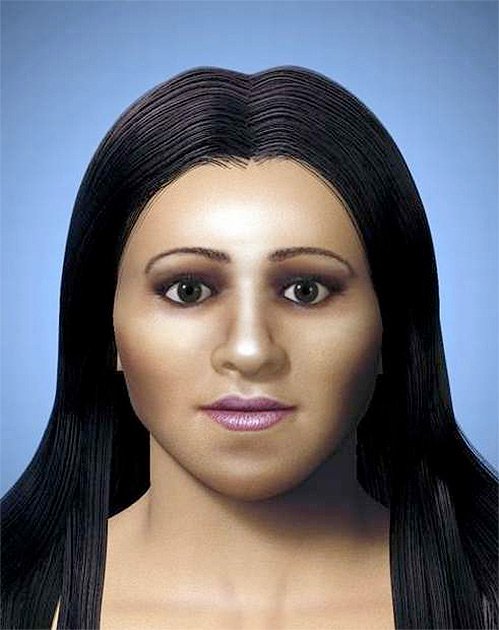
In the 1990s, Hilke Thür a Scholar of the Austrian Academy of Sciences theorised that an octagonal monument situated in the centre of Ephesus complex could be the tomb of Arsinoë. Professor Thür dated the building between 50 and 20 BC. In 1926, the skeleton of a young lady between 15 and 18 years old was found in the burial chamber. No inscriptions were found, but the octagonal shape of the tomb, resembling the second tier of the Lighthouse of Alexandria, the dating of the bones (200-20 BC), the gender of the skeleton and the age of the girl on her death led the Scholar to assume the skeleton belongs to Arsinoë.

Although a DNA test was impossible to perform, since the bones were handled too many times (the bones were packed and sent to Germany at the discovery, furthermore the skull was lost during World War II), Hilke Thür could examine old notes and photographs of the skull and, thanks to modern technologies and the expertise of forensic anthropologist Caroline Wilkinson, was able to show us what the woman may have looked like. Furthermore, evidences of African and Egyptian ancestry mixed with classical Greek Features appears. Naturally there is no evidence that also Cleopatra shared the same traits, indeed Arsinoë and Cleopatra shared the same Father, but not the same mother

Naturally, until Archaeologists won’t find the Tomb of Cleopatra and Mark Anthony, no essential proof can confirm the identity of the Skeleton, but the possibility of admiring the face of a person who lived the age of Julius Cesar, Cleopatra and Mark Anthony fascinates us.
 Simple History